
Change leadership is a function before it is a title
A change leader is the person or group that makes sure the leadership functions required by an organizational change are covered. The role is not limited to the executive who announces the initiative or the project professional who coordinates its tasks. Leadership during change can be enacted by different people and groups over time, while relationships, culture, and operating systems shape how that leadership works.
For HR directors and people leaders, this distinction changes the question. Instead of asking whether one executive has the right style, ask whether the organization has clear accountability for direction, communication, stakeholder alignment, manager support, readiness, issue resolution, and progress review. A title may help assign ownership, but a title alone does not cover the work.
The central problem is organizational: when change functions are scattered or assumed rather than assigned, managers may receive inconsistent direction, employees may not understand how the change affects their work, and sponsors may lack a clear view of adoption conditions. Treat that pattern as a design issue before treating it as an individual capability issue.
Change leadership is best defined here as a distributed capability and accountability system for helping an organization move through a change. Distributed does not mean ownerless. It means that senior sponsors, people managers, project teams, subject-matter specialists, and affected groups may each enact different leadership functions.
Organizational change capability also depends on more than individual behavior. It can include supportive structures and resources, human capability, organizational learning, change processes, and a context or culture that facilitates change. A useful role definition therefore connects leadership behavior with the conditions that allow people to apply it.
This article uses D³-Org—Diagnose, Decide, Develop—to turn that definition into an organizational route. First, locate the rupture. Next, choose a response that matches the gap. Then, build the accountability, support, and measurement system needed for implementation.
What a change leader must cover as the change evolves
Change leadership must cover different functions as an initiative moves from intention to implementation. The same person may not perform every function, but the organization should know who does.
A practical sequence includes:
- Create direction: explain the purpose, scope, objectives, and implications of the change in language that different groups can use in their work.
- Connect the system: align sponsors, project teams, people managers, and affected groups around responsibilities, decision rights, and dependencies.
- Read the impact: assess how the change affects workflows, teams, roles, culture, and relevant technology use.
- Support local leadership: help managers communicate, respond to concerns, coach teams, and surface issues rather than leaving them to interpret the initiative alone.
- Address resistance and readiness: identify persistent concerns, evaluate readiness, and choose actions that respond to the conditions behind them.
- Review progress: track issues, revisit assumptions, and measure whether the intended work and adoption conditions are changing as planned.
The emphasis should change as the organization learns. Early work often requires clear rationale, visible sponsorship, and role definition. During implementation, the emphasis shifts toward listening, coordination, manager support, and decisions under incomplete information. Later reviews should examine readiness, unresolved issues, and whether the affected work is operating under the intended conditions.
A change leader also needs behavioral variety. A single approach will not fit every situation, team, or stage of implementation. Depending on the workforce's competence and commitment, the appropriate approach may involve clearer direction, coaching, or more collaborative support. Use that flexibility as a response to observed conditions, not as a personal-style label.
The practical boundary is simple: assign the function before evaluating the person. If no one owns impact assessment or manager enablement, a development course cannot repair that missing accountability by itself.
Change leader, change manager, and stakeholder: a working role map
A change leader, change manager, and stakeholder can participate in the same initiative without holding the same accountability. The distinctions below are a working operating map, not a universal job-title taxonomy. Organizations may combine or separate these roles according to their structure.
| Role | Primary question | Typical accountability during change | Boundary |
|---|---|---|---|
| Change leader | What leadership functions must be enacted for this change to move? | Create alignment, connect people and systems, support decisions, mobilize participation, and ensure that leadership functions are covered across the change. | May be one person or several people; the role is defined by functions rather than title. |
| Change manager | What process, plan, activity, or control will help implement the change? | Define scope and objectives, assess effects, coordinate activities, communicate the rationale, facilitate workshops, track issues, and support readiness work. | The role coordinates implementation work; it does not automatically replace executive sponsorship or local manager accountability. |
| Stakeholder of change | How does this change affect my work, decisions, responsibilities, or interests? | Provide relevant input, respond to the change, raise concerns, participate in decisions or activities where assigned, and apply changed expectations within the person's area of responsibility. | The term identifies a relationship to the change, not a fixed level of authority or a universal role description. |
Role overlap is normal, but unspoken overlap creates risk. A senior sponsor may enact change leadership by setting direction and securing resources. A change manager may enact it by connecting plans, stakeholders, and readiness work. A people manager may enact it by translating the change into team routines and bringing feedback upward. An affected employee may contribute leadership by identifying a workability problem that the project team cannot see.
Use the map to ask three questions: who has the authority to decide, who has the responsibility to coordinate, and who has the experience needed to test whether the change works in practice? Record different answers when the initiative crosses functions or countries. Do not treat a stakeholder list as proof that leadership accountability has been assigned.
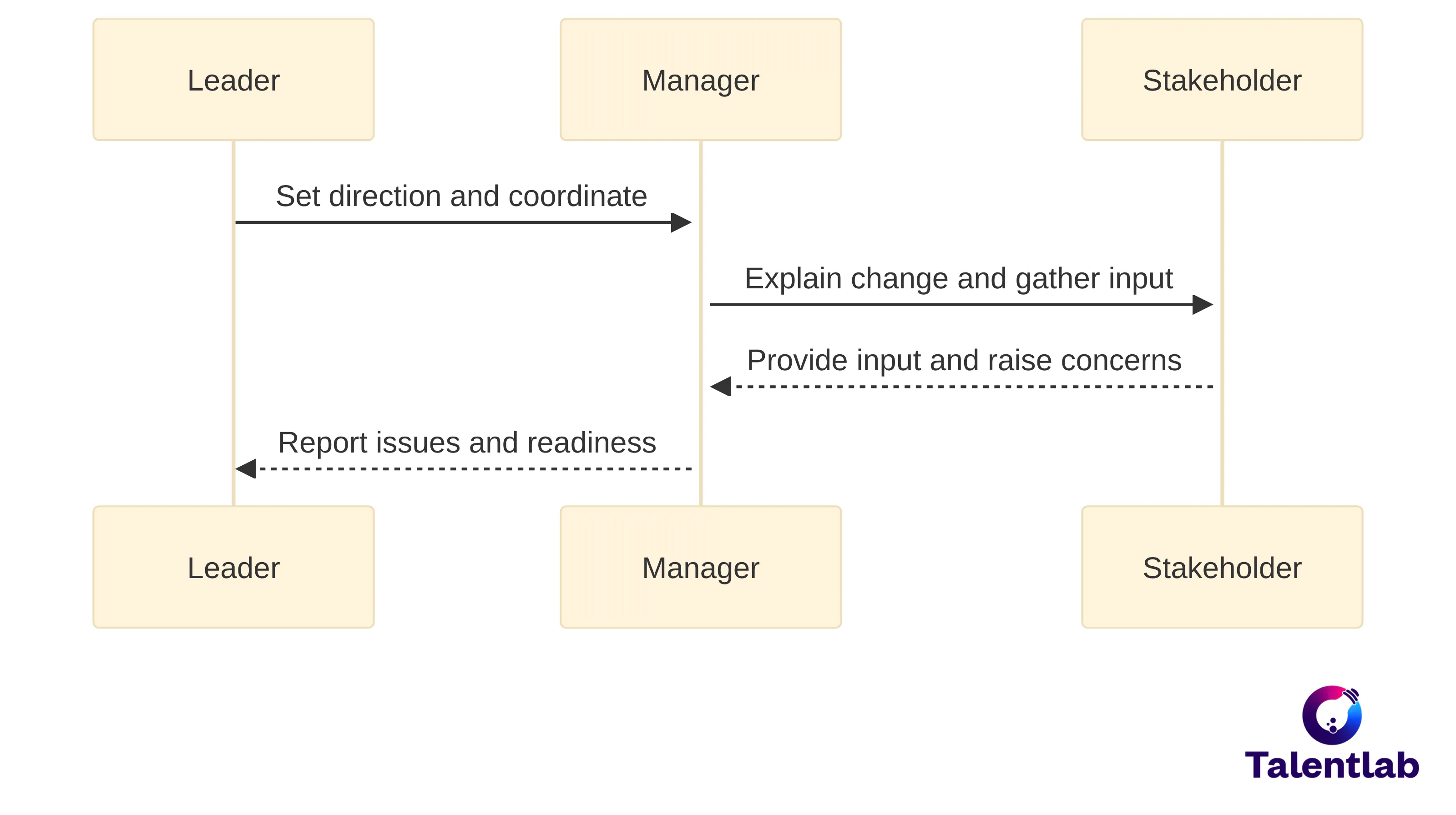
The responsibilities and capabilities behind change leadership
Change leadership responsibilities connect organizational intent with the conditions required for people to act. A useful responsibility set includes:
- Sponsorship and direction: maintain a visible rationale, long-term purpose, and adequate resources for the change effort.
- Impact and readiness assessment: examine effects on workflows, roles, teams, culture, and relevant technology fluency before selecting implementation actions.
- Stakeholder alignment: identify who must decide, contribute, communicate, or adapt, then connect those responsibilities to the plan.
- Manager enablement: equip people managers to explain the change, respond to concerns, coach teams, and report issues.
- Communication and participation: clarify what is changing, why it matters to different groups, and how feedback will influence implementation decisions.
- Resistance and issue management: identify persistent concerns, track issues, and address the conditions producing them.
- Measurement and review: define progress indicators, evaluate readiness, and revisit the route when conditions change.
The capabilities behind those responsibilities are both person-oriented and task-oriented. Relevant capabilities include agility, empathy, authenticity, critical thinking, relationship-building, resilience, and decision-making under uncertainty. Leadership capabilities support communication, mobilization, and evaluation across organizational levels during change.
These capabilities should be evaluated through work, not through a personality label alone. Ask whether a sponsor can create usable direction, whether a manager can hold a two-way conversation about impact, whether a project team can revise a plan from field information, and whether the governance group can make a decision when information is incomplete.
A capability is present only when the organization gives it a place to operate. Clear decision rights, time, resources, feedback channels, and support for managers determine whether a behavior can be applied. If those conditions are missing, classify the problem as partly systemic rather than assigning the entire burden to an individual's skill level.
Senior support is one of the conditions that allows change capability to develop. A dedicated sponsor, a long-term vision, funding, resources, and clear communication about the importance of the effort give other participants a basis for action. The sponsor does not need to perform every activity, but the sponsor should make the effort visible and governable.
For HR, this means a leadership development plan should be linked to the operating conditions in which leaders must apply what they learn. If the desired behavior depends on a decision right, workflow, incentive, or manager routine that has not changed, add that system work to the design.
How change leadership appears in organizational practice
Organizational change leadership appears in ordinary decisions and conversations, not only in executive announcements. The following examples are illustrative ways to inspect the role in practice.
- A technology implementation: The sponsor explains the purpose and secures resources; the change manager maps effects, readiness, and issues; people managers help teams understand new responsibilities and surface obstacles; affected groups provide feedback about day-to-day use.
- A role or operating-model redesign: The change team clarifies scope and responsibilities, leaders make decisions about authority, managers explain implications, and stakeholders test whether the proposed structure is workable in their area.
- A multinational leadership initiative: HR and business sponsors define the capability the organization needs, local managers connect that capability to work, and governance groups compare common requirements with market-specific implementation conditions.
- A change with persistent resistance: The team distinguishes a knowledge or skill gap from an unresolved process, resource, role, or trust issue before selecting training as the response.
Use each example as a role-coverage test. Can you identify who explains the rationale, who listens to concerns, who decides when trade-offs appear, who supports managers, and who reviews readiness and progress? If the answer changes by stage, document that change rather than assuming the original project owner will carry every function.
The test also protects against a narrow view of leadership. A person can hold a senior title and still lack the information needed to see a local work problem. A manager can have strong relationships and still lack authority to change a process. A change manager can maintain a detailed plan and still need a sponsor to resolve a decision. Effective coverage connects these contributions instead of ranking one role above the others.
Diagnose whether the gap is capability or system
Diagnose is the first D in D³-Org. The purpose is to separate a symptom from the condition producing it before HR chooses a leadership intervention.
A capability gap usually concerns a defined knowledge, skill, judgment, or behavior gap. A system constraint may involve roles, processes, governance, incentives, culture, resources, or adoption conditions. The two can reinforce each other, so avoid forcing every problem into one category.
Start with the work that should be happening and compare it with what is happening. Then ask where the break occurs: direction, role clarity, decision-making, manager behavior, communication, readiness, or the operating conditions that support application.
A practical diagnostic uses observable signals rather than a general impression. Review these questions:
- Direction: Can sponsors and managers explain the change's purpose, scope, and implications in consistent terms?
- Accountability: Are decision rights and responsibilities clear across sponsors, project teams, managers, and affected groups?
- Manager support: Do people managers have the information, time, and support required to communicate and respond to concerns?
- Readiness: Has the organization assessed preparedness and relevant technology fluency before expecting changed work?
- Issue flow: Are concerns, resistance, and implementation issues recorded, owned, and reviewed?
- Application: Does the desired behavior have a place in the process, role, governance, or routine where it must be used?
- Review: Does a governance group examine progress and decide when the route needs adjustment?
Interpret the pattern, not one isolated signal. If managers understand the change but cannot apply the expected behavior because the process or decision rights remain unchanged, select a system response. If the process is usable but managers lack a defined skill or judgment, select a focused development response. If both conditions exist, plan for both.
Write the diagnosis as a testable statement: the affected group is expected to do X, the current condition is Y, and the barrier appears to be Z. That statement gives HR a basis for deciding what to develop, what to redesign, and what to measure. It also prevents a broad leadership program from becoming a substitute for basic role and governance work.
Decide which organizational response fits the diagnosis
Decide is the second D in D³-Org. The response should match the diagnosed gap, the population affected, and the conditions required for application.
- Use focused leadership training when the diagnosis identifies a defined knowledge, skill, judgment, or behavior gap. Specify the work situation, practice task, feedback method, and organizational indicator that the training is meant to inform.
- Use a broader leadership development initiative when a recurring capability need affects multiple levels, roles, or the leadership pipeline. Define the population, shared expectations, manager involvement, learning experiences, and route for applying them in work.
- Use an organizational or change intervention when roles, processes, governance, incentives, culture, or adoption conditions constrain the desired behavior. Address the system condition directly instead of presenting training as the primary fix.
- Use a combined route when a capability gap and a system constraint reinforce each other. Pair the development activity with the specific system change needed for application.
A good decision has a visible link between diagnosis, intervention, owner, and measurement. A risky decision jumps from a visible symptom to a familiar program without identifying the mechanism.
Before approval, record four items:
- The behavior, decision, or work condition that must change.
- The evidence that identifies a capability gap, a system constraint, or both.
- The owner responsible for making application possible.
- The leading and lagging indicators that will show whether the response remains relevant.
This discipline also clarifies when to pause. If the organization has not defined the affected roles, sponsor accountability, or conditions for application, resolve those design questions before scaling a development intervention.
Develop the accountability system that supports implementation
Develop is the third D in D³-Org. Development means building the conditions, roles, tools, and review rhythm that let the chosen response operate in the change.
A practical 30/60/90 sequence can organize that work:
- First 30 days: define the change purpose, affected groups, role boundaries, decision rights, sponsor, manager responsibilities, readiness questions, and initial measures. Create the minimum sponsor, people-manager, communications, training, and issue-management deliverables needed for the initiative.
- By 60 days: enable the people who must carry the change locally, test the communication and feedback routes, review readiness signals, and resolve issues that block application. Separate a learning need from a process or governance problem as new information appears.
- By 90 days: review progress with the sponsor and relevant owners, compare leading signals with work conditions, decide what needs adjustment, and confirm which responsibilities continue through the next stage.
Governance should make accountability visible without turning every decision into a committee decision. Assign a sponsor for direction and resources, a change or project owner for coordination, people managers for local communication and support, and a review group for cross-functional issues and prioritization.
Give each role a small set of explicit questions. The sponsor asks whether the change remains strategically supported and resourced. The implementation owner asks whether activities, dependencies, and issues are moving. Managers ask what their teams need to understand and apply. HR or organizational-development leaders ask whether capability building and system changes remain aligned.
Set a review cadence that matches the pace and exposure of the change. Each review should end with an owner, a decision, and a next check. A meeting without an action boundary does not create accountability.
Implementation assets should reduce ambiguity for the people carrying the work. Prepare a sponsor plan, people-manager plan, communications plan, training plan, and resistance-management plan when the initiative requires them. Use a role map, issue log, readiness questions, decision record, and measurement sheet to connect those assets.
The immediate use of these tools is practical: the role map shows who acts, the decision record shows what was decided and why, the issue log shows what is unresolved, and the measurement sheet shows what the governance group will review. Keep each tool tied to a decision or action; do not create documents that no owner will use.
Assess whether change leadership is functioning
Change leadership is functioning when the organization can see who is responsible, what is happening, where the work is blocked, and which decision follows from the information. Measurement should therefore cover both leading signals and lagging conditions.
Leading indicators can include:
- sponsor communication and resource decisions;
- completion and use of manager enablement activities;
- clarity of roles and decision rights in affected areas;
- readiness checks and the quality of concerns raised;
- issue ownership, resolution movement, and feedback reaching the governance group.
Lagging indicators can include whether the affected work, process, role expectations, or relevant technology use is operating under the intended conditions. Choose the lagging measure from the purpose of the change rather than applying a generic score.
A useful reporting cycle connects each measure to an action. Operational owners can review activity, readiness, and issues frequently enough to respond while implementation is underway. A sponsor or steering group can review the broader pattern at an agreed interval and decide whether to continue, adapt, add system support, or pause.
Do not treat participation, completion, or positive sentiment as proof that the change is working. Those signals can show activity or experience, but they do not replace evidence about application and affected work conditions. Define the measurement boundary before the intervention begins, state what each measure can support, and avoid inventing a benchmark when the organization has no justified comparison.
Use this short review at each governance checkpoint:
- Which leadership functions were expected during this period?
- Which functions were enacted, by whom, and with what authority?
- What signal shows that managers and affected groups understand their responsibilities?
- What unresolved issue is blocking application or readiness?
- Does the obstacle require capability building, system change, or both?
- What decision will the sponsor or governance group make next?
The checklist turns measurement into a decision aid. It does not guarantee an outcome, but it gives HR a repeatable way to examine accountability, support, communication, and implementation conditions.
Adapt the role across Mexico, Latin America, and the United States
Change leadership can be treated as a set of functions enacted by different individuals or groups during a change, not only as the responsibility of one designated leader..
Use the same functional questions in each market:
- Who sponsors the change and controls the resources needed for application?
- Which decisions are global, regional, or local?
- Which managers must translate the change into team work?
- How will affected groups raise concerns and receive responses?
- What readiness, issue, and progress signals will each market report?
- Which elements must remain consistent, and which can be adapted to local work conditions?
A useful regional role map records both the common standard and the local owner. For example, a global sponsor may define the intended direction while regional or country leaders clarify execution conditions and escalate conflicts. People managers remain essential because local application depends on the conversations and decisions closest to the work.
Do not treat regional adaptation as a reason to create unrelated role definitions. Compare the same accountability questions across markets, document meaningful differences, and give the governance group a way to resolve them. That approach supports consistency without assuming that one communication style, meeting rhythm, or implementation route will fit every operating context.
Define the role before building change leadership capability
Change leadership becomes actionable when HR defines the functions, assigns accountability, and connects development decisions to the conditions of the work. Start with a role map, diagnose capability and system gaps separately, choose a matching response, and establish governance and measurement before expanding the initiative.
For an organization-specific design, a qualified HR or change professional should determine suitability for the relevant roles, operating conditions, and implementation decisions. The immediate organizational task is clear: do not ask a course or a title to carry responsibilities that the system has not assigned.
Use that boundary to guide leadership development across multinational teams. Build common expectations where the organization needs consistency, adapt implementation where local conditions require it, and review the functions as the change evolves.
A defined sponsor, supported managers, clear decision rights, usable feedback routes, and a measurement cadence give the change effort a structure that people can act within. Begin by documenting those conditions and the decision each one is meant to support.
Practical questions HR leaders should resolve before assigning the role
What are the core responsibilities of a change leader?
A change leader is responsible for creating direction, connecting the system, assessing impact, supporting local leadership, addressing resistance and readiness, and reviewing progress throughout the change initiative.
How does a change leader differ from a change manager?
A change leader focuses on enacting leadership functions necessary for change, while a change manager is responsible for defining processes and coordinating activities to implement the change.
What capabilities are important for effective change leadership?
Key capabilities for change leadership include agility, empathy, authenticity, critical thinking, relationship-building, resilience, and decision-making under uncertainty.
How can organizations assess whether their change leadership is functioning effectively?
Organizations can assess change leadership effectiveness by tracking leading indicators such as communication clarity, manager enablement, and issue resolution, as well as lagging indicators like the operational conditions of affected work.
What role does senior leadership play in change leadership?
Senior leadership provides sponsorship, direction, and resources, which are essential for establishing a supportive environment for change and enabling other leaders to act effectively.
How should organizations adapt change leadership practices across different regions?
Organizations should maintain core change leadership functions while adapting the execution of those functions to fit local responsibilities, decision routes, and implementation conditions in different regions.
What is the D³-Org framework and how does it relate to change leadership?
The D³-Org framework—Diagnose, Decide, Develop—guides organizations in identifying gaps in change leadership capabilities, selecting appropriate responses, and establishing the necessary conditions for effective implementation.