

Cultural change is a shift in how the organization operates
Cultural change is a shift in an organization’s shared values, norms, and behaviors. The work becomes actionable when you connect the culture the business needs with observable behavior, leadership practice, and the systems that shape daily decisions. Culture change can form part of a broader organizational change initiative, but it needs its own approach and timeline because it concerns how people interpret and enact the organization’s operating expectations.
For HR directors and people leaders across Mexico, Latin America, and the United States, the practical question is not whether the organization has a culture. Every organization has patterns about authority, collaboration, risk, escalation, performance, and learning. The decision is which patterns support the business direction, which patterns create friction, and which organizational conditions keep those patterns in place.
That gap matters because employees use leadership behavior, processes, incentives, and social signals to determine what the organization actually expects. A culture diagnosis can examine artifacts, values, daily behaviors, underlying assumptions, and patterns across groups.
This guide uses a three-part route: Diagnose the system behind the visible pattern, Decide which cultural priority deserves organizational attention, and Develop the leadership, participation, governance, and measurement conditions needed to support adoption. The route does not promise a fixed result. It gives you a disciplined way to decide what to change, where to adapt it, and when to adjust.
Organizational culture change can be assessed through dimensions such as adaptability, employee relations, alignment with external demands, flexibility, involvement, consistency, and mission. These dimensions are useful as prompts for inquiry, not as a universal scorecard. A multinational organization can use the same decision logic across countries while allowing local teams to explain how the pattern appears in their work.
The first boundary is organizational. This guide focuses on leadership, capabilities, processes, governance, and adoption. It is not an individual self-improvement plan, and it does not treat a training course as a substitute for changing the conditions around behavior.
Start with the behavior the business needs to see
The target behavior is the most useful starting point for cultural change because values become actionable only when people can recognize them in work. Begin with the business situation that requires a different way of operating, then describe the behavior that would make that way of operating visible.
A useful behavior statement answers four questions:
- What decision, interaction, or work practice needs to change?
- Who needs to act differently, and in which setting?
- What would you see or hear if the behavior were present?
- Which business priority does the behavior support?
For example, “be more collaborative” is too broad to guide implementation. A more usable statement might specify that regional and corporate leaders bring relevant tradeoffs into a shared decision forum before committing resources. The statement does not assume that one meeting will solve coordination. It gives you something to observe, discuss, and connect to existing governance.
Behavioral precision also prevents a common error: treating a cultural label as a diagnosis. “The culture is resistant” describes an interpretation. It does not explain whether resistance comes from unclear decision rights, conflicting incentives, limited capability, weak sponsorship, or a lack of trust in the proposed change. Translate the label into observable behavior before choosing an intervention.
The target culture should support business strategy, organizational structure, sustainability, and ethical principles. Test the behavior against the structures that are meant to reinforce it by asking whether reporting relationships, job descriptions, hiring, performance appraisal, rewards, and development practices send the same message.
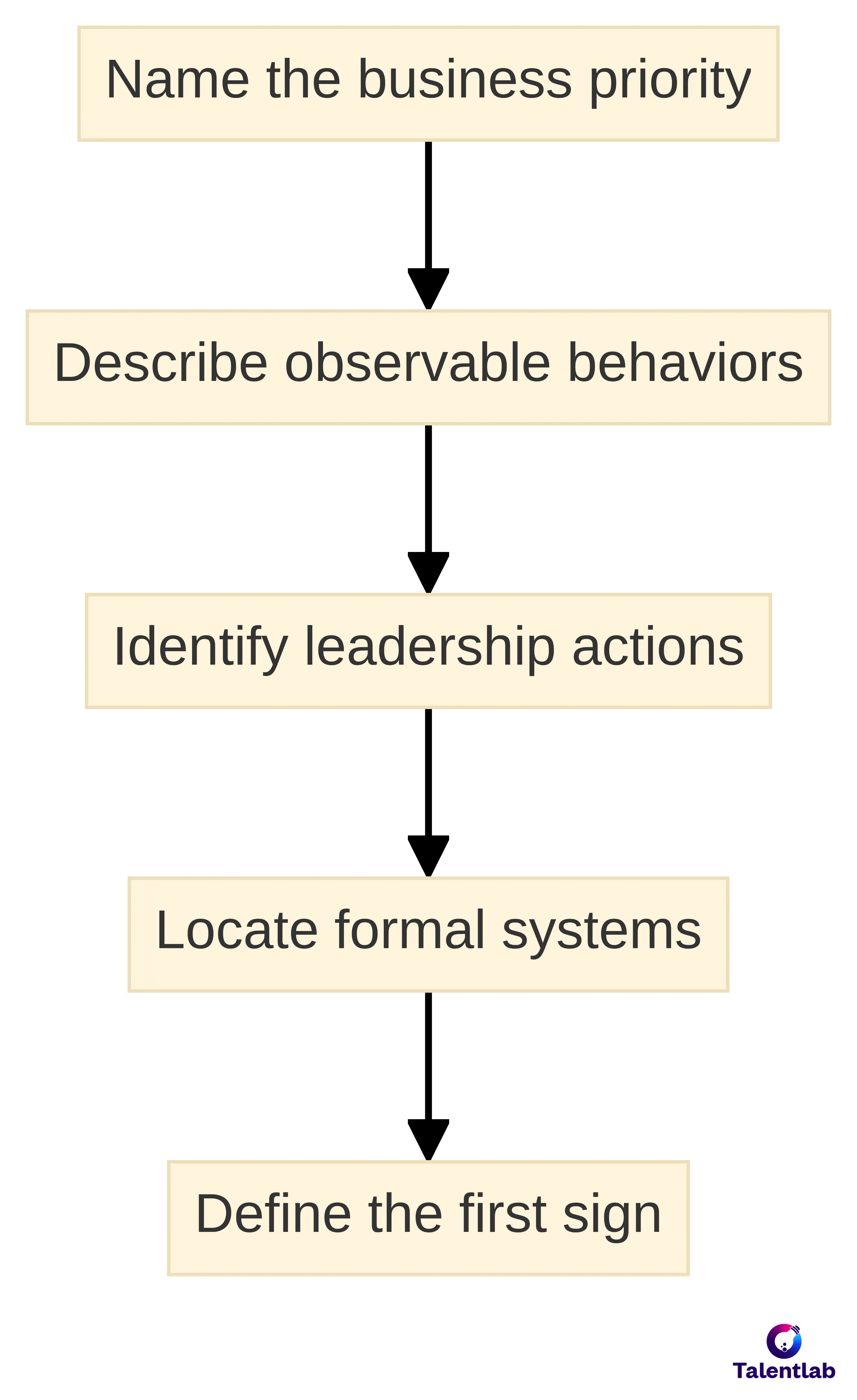
Use the following sequence to define the target:
- Name the business priority that makes the cultural shift necessary.
- Describe two or three observable behaviors that support that priority.
- Identify the leadership actions that would make those behaviors credible.
- Locate the formal systems that could reinforce or contradict the behaviors.
- Define the first sign that the behavior is appearing in routine work.
A target that cannot be observed cannot guide diagnosis or measurement.
Read the gap between stated culture and lived practice
The gap between stated culture and lived practice is the difference between what the organization says it values and what its systems reward, tolerate, or make possible. Diagnose that gap by examining artifacts, stated values, daily behaviors, underlying assumptions, and recurring patterns across groups.
Artifacts include the visible traces of how work happens: meeting routines, decision records, escalation paths, promotion criteria, recognition practices, language used by leaders, and the way priorities are communicated. Values describe the principles the organization names. Daily behaviors show what people actually do under pressure. Underlying assumptions explain why a pattern feels reasonable to the people who repeat it.
A diagnosis becomes more useful when you place these layers beside one another. If an organization values learning but treats errors as reasons for blame, the relevant question is not whether employees understand the value. The question is which leadership and performance conditions make experimentation difficult. If an organization values regional ownership but requires every material decision to move through a central office, the gap may sit in decision rights rather than motivation.
Use interviews, group discussions, document review, existing people data, and direct observation only when each method answers a defined question. The point is not to collect every possible opinion. The point is to connect a visible pattern to the system that sustains it.
Cultural symptoms describe what you can see; organizational causes explain what keeps the pattern in place. Separate the two before approving a response.
| What you may observe | Questions about the underlying system |
|---|---|
| Decisions repeatedly return to senior leaders | Are decision rights clear, and are leaders rewarded for delegation or control? |
| Teams describe collaboration as a stated value but protect local priorities | Do goals, resources, and performance reviews reward shared outcomes? |
| Managers avoid difficult feedback | Do leaders model direct feedback, and do managers have the skills and authority to use it? |
| Regional teams apply a global process unevenly | Which parts of the process require common standards, and which parts require local adaptation? |
| Employees attend change activities but do not use the new practice | Are time, tools, reinforcement, and leadership attention available after the activity? |
Culture frameworks can assess adaptability, involvement, consistency, mission, and related dimensions. Those dimensions help organize inquiry, but they do not by themselves identify the cause of a local pattern. Treat each score or theme as a prompt for a more specific question.
Test whether the diagnosis reflects the whole system
A cultural diagnosis reflects the whole system only when it connects employee experience with leadership practice, formal processes, and business conditions. A single favorable or unfavorable perception does not establish a culture-wide cause.
Test the diagnosis across four views:
- Experience: What do people report about trust, decision-making, inclusion, accountability, and everyday cooperation?
- Behavior: What do managers and teams do when priorities conflict, deadlines tighten, or risks become visible?
- System: Which structures, processes, incentives, and roles reinforce the behavior?
- Context: Does the pattern appear across functions, levels, countries, or business units, or is it concentrated in a particular setting?
Repeating the inquiry with different groups helps identify patterns across groups and shows where local adaptation may be needed. A pattern that appears in several regions may justify a shared organizational response. A pattern that appears in one function may call for a more contained process or leadership intervention. Neither conclusion should be made from a label alone.
Readiness is visible in the conditions available for action, not in enthusiasm expressed during a launch meeting. Check whether people understand the reason for the change, have a meaningful way to influence its design, know what they must do differently, have the skills and tools required, and will receive reinforcement after the initial communication.
Listen to objections. Objections can point to an awareness problem, a lack of desire to participate, missing knowledge or skills, or a barrier in the operating environment. Each condition calls for a different response. The setting was specific to U.S. and Canadian AEC firms, so use the finding as a caution against single-intervention planning rather than as a benchmark for a multinational culture initiative.
Treat leadership behavior as a condition of adoption
Leadership behavior is a condition of cultural change because employees interpret the credibility of the target culture through what leaders do. Strong leadership support and visible leadership championship are identified as essential to cultural change, while a systematic review associates leader openness with more positive reactions to change and leader resistance with more negative reactions.
One systematic review reports that leadership contributed 71% of change success among employees in the cited research. That figure belongs to the research reviewed and should not be treated as a universal forecast for your organization. The practical implication is narrower: assess leadership behavior as part of the change system instead of measuring employee attitudes while leaving leadership practice unexamined.
Ask leaders to demonstrate the target behavior in decisions that carry real consequences. If the target is collaboration, the executive team should make tradeoffs visible and use shared criteria. If the target is accountability, leaders should explain ownership, follow through on commitments, and respond consistently when priorities change. If the target is learning, leaders should show how the organization examines setbacks without turning every problem into individual blame.
Leadership assessment should examine actions rather than declarations. Use a short review such as the following:
- Identify the leadership behaviors that support the target culture.
- Ask employees and managers where those behaviors are visible in routine work.
- Compare leadership messages with decisions about priorities, resources, accountability, and recognition.
- Document the leadership actions needed to address observed gaps.
- Assign each leadership behavior an owner and a review point.
This sequence keeps accountability with the system and gives leaders a concrete role in adoption.
Convert signals into a decision about priority
A cultural priority is worth pursuing when the pattern is material to the business direction, visible in more than one relevant signal, and connected to conditions the organization can influence. The priority should also be specific enough to guide a leadership action, a system adjustment, and a progress measure.
Use five decision questions:
- Strategic relevance: Which business priority does the cultural pattern affect?
- Behavioral clarity: Can you describe the behavior that must change?
- System connection: Which structure, process, incentive, or capability reinforces the current pattern?
- Leadership ownership: Which leaders can change the conditions around the behavior?
- Measurement: What observable movement would indicate that the organization is acting differently?
A priority is at risk when it is a broad label, depends only on individual goodwill, has no accountable owner, or cannot be connected to a practical change in work. A priority is more actionable when it identifies a behavior, a system condition, a responsible group, and a review cadence.
Use qualitative thresholds when hard benchmarks are unavailable. A priority is ready for action when the diagnosis shows a repeated pattern, the target behavior is clear, leadership can influence the relevant conditions, and the organization can observe movement over time. A priority remains at risk when the organization cannot agree on the desired behavior, the proposed intervention sits outside the owner’s authority, or the target conflicts with business strategy and structure.
Culture frameworks can organize the decision around adaptability, involvement, consistency, mission, external alignment, and related dimensions. Those dimensions do not tell you which intervention to buy or which target to announce. They help you state the decision in operational terms: what must change, for whom, under which conditions, and how the organization will know that the pattern is moving.
The D³-Org route keeps the sequence disciplined. Diagnose the symptom and cause. Decide which priority deserves attention and what “good” and “risk” look like. Develop the implementation conditions instead of treating the decision as complete when a program is selected.
Choose interventions that change the conditions around behavior
An intervention should change the conditions around the target behavior, not only explain the desired value. Align the target culture with business strategy and organizational structure, then review the formal mechanisms that shape daily work: reporting relationships, job descriptions, hiring, performance appraisal, rewards, and development practices.
Choose the smallest connected set of actions that addresses the diagnosed cause. A leadership workshop may be appropriate when managers need a shared language and practice. It is not enough when performance criteria reward the opposite behavior. A process redesign may be necessary when decision rights create the pattern. It is not enough when leaders continue to override the agreed process. A communication plan may clarify the reason for change. It is not enough when people lack the knowledge, skill, time, or reinforcement needed to act.
Build the intervention around three layers:
- Leadership: What must executives and managers model, decide, or stop doing?
- Operating system: Which roles, routines, measures, incentives, or processes must support the behavior?
- Capability and adoption: What do people need to understand, practice, use, and receive after launch?
The intervention choice should follow the barrier. Use this decision rule:
- If people do not understand the reason or expected behavior, address awareness and sense-making.
- If people understand the change but do not see a credible role for themselves, create meaningful participation and clarify consequences.
- If people want to act but lack knowledge or skills, provide practice, tools, and manager support.
- If people can act but the system blocks them, remove process, authority, resource, or incentive barriers.
- If the behavior appears briefly and then fades, establish reinforcement, recognition, and recurring review.
The study covered U.S. and Canadian AEC firms. Use it as a design warning: do not assume that one activity represents a complete adoption plan. In that study, very successful adoption cases additionally used change agents and a realistic timeframe highly effectively; those elements can inform planning without becoming a guaranteed recipe for your organization.
Design participation and regional adaptation into the route
Meaningful participation gives people throughout the organization a role in shaping how the target culture becomes work. Participation is not a request for universal agreement, and it is not a substitute for executive accountability. It is a way to surface operational barriers, test whether the behavior makes sense in different settings, and build ownership around the implementation choices.
Define participation before launch:
- Invite representatives from corporate, regional, functional, and frontline management groups that experience the change differently.
- Give each group a defined question to answer rather than asking for unrestricted opinions.
- Record which suggestions affect the target behavior, process, or support model.
- Explain which decisions are open for adaptation and which are required for governance or risk reasons.
- Return the decision and its rationale to the participating groups.
Listening to objections should come before assigning a negative label to them. A concern about workload may identify a capacity barrier. A concern about fairness may identify an unclear decision rule. A concern about local relevance may identify a design that needs adaptation.
Regional adaptation should preserve the target behavior while allowing the route into that behavior to fit the local operating context. Repeat the diagnostic inquiry with different groups and compare what remains consistent with what changes by country, function, level, or business unit.
Keep three elements common where the organization needs coherence:
- The business reason for the cultural shift.
- The target behaviors and the boundaries around them.
- The measures used to review organizational movement.
Adapt the examples, language, participation method, manager tools, learning format, and local implementation sequence when the context requires it. A common target does not require identical expression in every location. A local variation should still make its connection to the shared business priority clear.
Culture frameworks that examine adaptability, involvement, consistency, mission, and external alignment can help compare patterns across groups. Use them to structure dialogue, not to erase the differences that the dialogue reveals.
Govern adoption through owners, support, and review
Governance turns cultural change from an announced intention into a managed organizational route. Assign ownership for the target behavior, the supporting system changes, the manager experience, the regional adaptations, and the measurement cycle.
A practical governance design includes:
- Executive sponsor: protects the business purpose, resolves conflicts, and models the target culture.
- HR or people lead: coordinates diagnosis, capability support, participation, and reporting.
- Business owners: connect the target behavior to operating decisions, resources, and performance expectations.
- Regional or functional representatives: identify local conditions and manage approved adaptations.
- Managers: translate the behavior into team routines, discuss barriers, and reinforce use in daily work.
- Measurement owner: maintains the baseline, tracks agreed indicators, and brings decisions to review.
A governance role should have authority over a defined decision, not only a title. Specify what each owner can decide, what requires escalation, and which signals trigger a change in the route.
Use a staged route when the organization needs to build the conditions before scaling. The following 30/60/90 structure is a planning device, not a promise that cultural change will occur within 90 days.
- First 30 days: confirm the business priority, target behaviors, affected groups, system causes, owners, and baseline measures. Listen to objections and document the barriers that need action.
- By 60 days: test the manager tools, participation model, learning support, process adjustments, and regional adaptations with the groups responsible for using them. Resolve conflicts between the target behavior and existing systems.
- By 90 days: review early behavior and adoption signals, decide what to scale or adjust, and confirm the next measurement cycle. Keep leadership attention on the operating conditions rather than treating launch activity as completion.
Review adoption on a regular cadence that matches the pace and consequence of the initiative. A monthly operational review can address barriers and ownership; a less frequent executive review can address strategic alignment, resource conflicts, and whether the priority remains material. The correct cadence is the one that allows action before a known barrier becomes a routine failure.
Manager support should include the language, tools, practice, and escalation paths required to use the target behavior. Reinforcement should make the behavior visible after the launch period through recognition, review questions, decision records, or other established routines.
If adoption stalls, return to the barrier rather than repeating the same message. Lack of awareness, desire, knowledge, skills, or reinforcement requires different responses. This distinction gives the governance group a practical adjustment path and keeps the organization from treating every implementation problem as an attitude problem.
Measure movement without claiming transformation
Measurement should show whether the organization is moving toward the target behavior and whether the conditions around that behavior are changing. Quantitatively measure current cultural values to establish a baseline, assess the scale of change needed, support accountability, and track movement over time.
Build the measurement plan before implementation begins. Define the target behavior, the groups affected, the data source, the owner, the review cadence, and the decision that each measure can support. Do not collect indicators that cannot lead to an action.
A balanced plan can include:
- Leading indicators: participation in defined activities, manager use of agreed tools, completion of process changes, visibility of leadership actions, reported clarity about the target behavior, and the number or type of barriers resolved.
- Behavior indicators: observed use of the target behavior in meetings, decisions, feedback, escalation, collaboration, or other relevant work routines.
- System indicators: alignment of role expectations, performance discussions, rewards, reporting relationships, and development support with the target culture.
- Lagging indicators: business or people outcomes that the initiative is intended to inform, interpreted alongside other factors rather than attributed automatically to culture change.
Use a measure only when its meaning, limits, and decision use are clear.
A reporting cycle should distinguish activity from adoption. Attendance at a workshop shows that an activity occurred. It does not establish that the target behavior is being used in work. A favorable perception may show a change in experience. It does not establish that a process, leadership practice, or business outcome has changed.
Review measures through three questions:
- What movement is visible in the target behavior or its supporting conditions?
- Where is movement uneven across functions, regions, levels, or groups?
- What decision follows: continue, adapt, add support, remove a barrier, or pause?
Cultural change is described as an ongoing process of improvement and adaptation with regular measurement and evaluation. Keep the plan open to adjustment. A measure that exposes a new barrier is useful when it leads to a better decision; it is not a failure of the measurement plan.
The 2022 study of 633 change-adoption cases in U.S. and Canadian AEC firms illustrates why context belongs beside measurement. Its findings concern a defined industry sample and change-adoption setting. They can inform questions about combined strategies, change agents, and realistic timeframes, but they cannot supply a benchmark for cultural change across Mexico, Latin America, or the United States.
Use your own baseline and keep the interpretation bounded to the population, period, and decision being reviewed. That discipline is more useful than importing a number that does not describe your operating context.
Recognize what the evidence cannot establish
A cultural change plan cannot establish a guaranteed business result from an intervention alone. Leadership behavior, system alignment, participation, capability, reinforcement, and external conditions can all affect what happens after implementation.
A systematic review’s finding that leadership contributed 71% of change success among employees belongs to the cited research and is not a universal forecast. The AEC study’s findings came from 633 cases in U.S. and Canadian architecture, engineering, and construction firms, so they should not be presented as a multinational culture benchmark. These boundaries do not make the findings unusable. They define the questions the findings can help you ask.
Avoid four claims unless your own design and measurement support them:
- That a stated value has become a lived norm because communication was completed.
- That participation proves commitment to the change.
- That a training activity caused a business outcome without examining other conditions.
- That a score represents the entire organization when the sample covers only selected groups.
Use precise language: the initiative is designed to support a behavior, the measure shows movement in a defined population, or the process identifies a barrier for action. Those statements keep the conclusion proportional to what was actually observed.
The practical boundary is that cultural change requires continuing alignment among strategy, structure, leadership, participation, and measurement. A target culture that conflicts with reporting relationships, performance appraisal, rewards, or development practices will need system changes, not only a stronger message. A plan that lacks visible leadership support or regular evaluation should be treated as incomplete.
Pause or revise the route when the organization cannot define the behavior, assign ownership, explain the business connection, or identify a measure that would change a decision. A pause is a governance action. It protects the organization from scaling an unclear intervention across regions before the operating problem is understood.
Decide whether external support fits the operating problem
External support fits the operating problem when your organization needs help connecting diagnosis, leadership practice, system alignment, capability development, regional implementation, and measurement into one managed route. The relevant question is not whether an external provider has a generic culture program. The relevant question is whether its work can address the specific behavior and system conditions your diagnosis identifies.
Use these criteria in the decision:
- The support begins with the organizational priority and observable behavior rather than a preselected activity.
- The approach distinguishes cultural symptoms from the processes, incentives, leadership actions, or capabilities that sustain them.
- The design includes participation, manager support, regional adaptation, governance, and a review cadence.
- The measurement plan defines what will be observed, for whom, when, and what decision each signal can inform.
- The scope matches the organization’s authority, capacity, and need for internal ownership.
We offer tailored and flexible strategies and solutions for human capital management, bring a strategic business vision to our human capital management services, and offer a Change Management model that applies processes, tools, and techniques to manage the human side of change. We also apply an Agile Change Adoption Model to manage the human side of change, support organizations in developing leaders and teams, and recommend using evidence and analytics to inform talent and culture decisions.
The decision path is clear: define the behavior the business needs, diagnose the systems around it, decide which priority is actionable, develop the leadership and adoption conditions, and measure movement without overstating what the measures prove. Treat cultural change as an operating decision with owners and review points, not as a message that can stand apart from daily work.
A qualified professional should determine the suitability of any specific intervention for your organization, its jurisdictions, and its operating conditions. Your next step is to use the decision criteria above to frame the leadership, capability, and culture problem that requires structured support.
What should sponsors clarify before starting cultural change?
What is cultural change in an organization?
Cultural change refers to a shift in an organization’s shared values, norms, and behaviors, focusing on how people interpret and enact the organization’s operating expectations.
How can I diagnose the need for cultural change?
Diagnosing cultural change involves examining artifacts, stated values, daily behaviors, underlying assumptions, and patterns across groups to identify gaps between stated culture and lived practice.
What steps should I take to implement cultural change?
To implement cultural change, start by defining the target behavior, diagnosing the system behind current patterns, deciding on actionable priorities, and developing leadership and governance conditions to support adoption.
What role does leadership play in cultural change?
Leadership is crucial in cultural change as employees interpret the credibility of the target culture through leaders' actions. Strong leadership support and visible commitment are essential for successful change.
How can I measure the effectiveness of cultural change initiatives?
Effectiveness can be measured by tracking leading indicators such as participation in activities, observed behaviors, and alignment of systems with the target culture, while also considering lagging indicators related to business outcomes.
When should I consider external support for cultural change?
External support is beneficial when your organization needs help connecting diagnosis, leadership practice, system alignment, capability development, and measurement into a cohesive change strategy.