Start With Culture as an Operating Pattern
Organizational culture is an operating pattern made up of shared assumptions, symbols, beliefs, routines, language, and myths that shape how people behave and make sense of work. If you lead HR, organizational development, or transformation, culture types can help you describe that pattern without treating a label as a final diagnosis. The useful question is not which label sounds attractive; it is which assumptions and routines are shaping decisions, leadership behavior, collaboration, and execution in your organization.
Different types of organizational culture are analytical lenses rather than universally exhaustive categories. Organizational culture can also be examined through several other typologies, including weak versus strong, pragmatic versus bureaucratic, conservative versus innovative, hierarchical versus egalitarian, and individualist versus collectivist. Each lens highlights a different tension. Use the lens that helps you investigate the decision in front of you, then test the label against observable practices.
A practical starting sequence is:
- Name the pattern you think is present.
- Identify the decisions and behaviors that support that interpretation.
- Compare the current pattern with the culture your strategy requires.
- Gather employee and operating evidence before selecting an intervention.
That sequence keeps culture analysis connected to organizational choices rather than turning it into a personality exercise.
Knowledge-management research also supports restraint about universal conclusions. One meta-analysis used knowledge-management process data with k = 32 and N = 6,835, and culture-type relationship data with k = 7 and N = 865. Those figures describe the analyses and samples used for that research question; they do not establish that one culture type should be used by every organization. The four-type comparison that follows is therefore a way to structure inquiry, not a shortcut around organizational evidence.
Compare Four Culture Types Across Two Competing Tensions
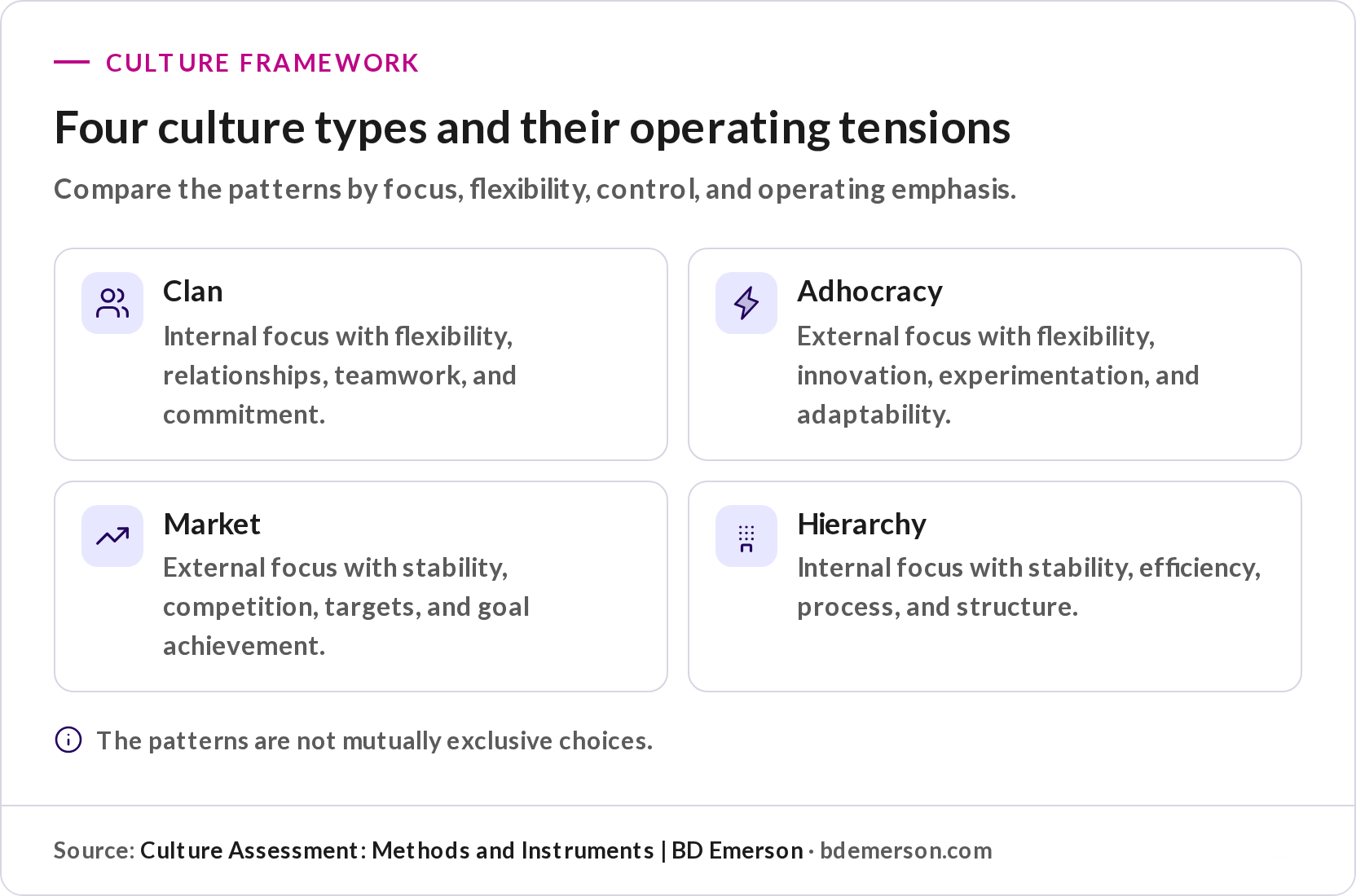
The Competing Values Framework compares four culture types through two tensions: internal versus external focus, and flexibility versus stability or control. The framework traces back to a 1983 study that identified two underlying tensions rather than one right answer about organizational effectiveness. That design matters for decision-making because organizations often need to support values that pull in different directions, such as collaboration and accountability or experimentation and control.
| Culture type | Primary focus | Operating emphasis | Questions to investigate |
|---|---|---|---|
| Clan | Internal | Flexibility, relationships, teamwork, and commitment | How are trust, collaboration, and employee well-being reinforced? |
| Adhocracy | External | Flexibility, innovation, experimentation, and adaptability | How are ideas tested, and how are they connected to external success? |
| Market | External | Stability or control, competition, targets, and goal achievement | Which measures, quotas, and results shape daily priorities? |
| Hierarchy | Internal | Stability or control, efficiency, process, and structure | How do rules, authority, and process guide decisions? |
The four patterns are not mutually exclusive choices. A business unit may rely on hierarchy for compliance, clan practices for collaboration, market expectations for commercial performance, and adhocracy practices for innovation. Compare the patterns by asking which one is most visible in a specific decision or operating system, not by assigning a single permanent identity to the whole organization.

Recognize the Clan Pattern in Relationships and Teamwork
A Clan culture combines internal focus with flexibility and emphasizes relationships, teamwork, commitment, collaboration, employee well-being, and open communication. The pattern is visible when the organization gives substantial attention to how people work together, how teams share responsibility, and how leaders build commitment around a common purpose.
To test for a Clan pattern, examine the operating choices behind the language of collaboration:
- Do leaders create time and forums for teams to solve problems together?
- Do managers develop commitment through communication and participation?
- Do employees experience teamwork as part of how work is organized, rather than as an informal expectation added to already full workloads?
- Do decisions preserve relationships while still making ownership clear?
These questions distinguish a supported collaboration pattern from a slogan about belonging. Your evidence should come from leadership behavior, team routines, decision records, and employee perceptions.
A Clan pattern can guide leadership and culture decisions toward collaboration, communication, commitment, and development practices. Leadership culture shapes how leaders communicate, make decisions, develop employees, and reinforce organizational values, and those behaviors directly influence organizational culture. If the strategy requires stronger cross-team coordination, compare the stated value of teamwork with the way leaders allocate attention, make tradeoffs, and recognize contribution.
Recognize the Adhocracy Pattern in Innovation and Adaptability
An Adhocracy culture combines external focus with flexibility and emphasizes innovation, experimentation, creativity, risk-taking, and adaptability. The pattern appears when the organization treats new ideas and rapid learning as central to how it responds to external conditions. Flexibility alone is not enough; the operating question is whether experimentation is connected to a meaningful business direction.
Adhocracy signals can be found in the way ideas move from discussion to testing. Look for:
- Permission to propose and test new approaches.
- Decisions that allow learning before full-scale commitment.
- Leadership responses that distinguish a useful experiment from an avoidable failure.
- Clear links between new ideas, market growth, and company success.
These signals help you separate genuine adaptability from constant change without learning. Ask which experiments have an owner, what decision they are intended to inform, and how the organization decides whether to continue, adapt, or stop.
An Adhocracy pattern can inform actions that strengthen experimentation while preserving a connection to external outcomes. If your organization needs more adaptability, do not infer that every process should become less structured. Compare the flexibility required by the strategic challenge with the controls needed to evaluate ideas, allocate resources, and convert learning into a decision.
Recognize the Market Pattern in Competition and Results
A Market culture combines external focus with stability and control and emphasizes competition, goal achievement, profitability, targets, quotas, and results. The pattern is visible when external success provides the main reference point for priorities and when performance expectations are translated into measurable goals. Market cultures stress meeting quotas, reaching targets, and getting results.
To assess a Market pattern, trace what the organization measures and what those measures change:
- Which performance metrics receive attention in operating reviews?
- How are targets translated into team and individual responsibilities?
- Do quotas or other goals influence resource allocation, recognition, and escalation?
- Does the pursuit of external results shape how leaders define acceptable tradeoffs?
Market cultures focus on performance metrics, while learning cultures emphasize development and capability. That contrast gives you a useful diagnostic question: does the measurement system leave room for capability-building when short-term results are under pressure?
A Market pattern can guide work on goal clarity, performance management, and leadership accountability when external results are central to the strategy. It does not establish that competition or profitability should dominate every decision. Compare the results the organization needs with the behaviors its targets create, then investigate whether the current measurement system supports the operating pattern you intend to keep.
Recognize the Hierarchy Pattern in Structure and Efficiency
A Hierarchy culture combines internal focus with stability and control and emphasizes efficiency and process. Hierarchy cultures also emphasize structure, rules, a clear chain of command, stability, and efficiency. The pattern is most visible in how authority is defined, how work is standardized, and how the organization manages consistency across teams or locations.
Hierarchy signals appear in the architecture of decisions and workflows. Examine:
- Where final decision rights sit and how many approvals a significant choice requires.
- Which rules or procedures determine how work is performed.
- How exceptions are handled when a standard process does not fit.
- Whether reporting lines and spans of control support the work the organization needs to do.
Centralized cultures often align with hierarchical structures, while decentralized cultures rely on flatter models. Use that relationship as a question about operating design, not as proof that a structure is effective or ineffective.
A Hierarchy pattern can inform decisions about process clarity, authority, consistency, and operational control. If your organization is trying to respond faster, do not remove structure by default. Identify which controls protect quality or compliance, which approvals delay necessary action, and which decision rights should remain centralized or move closer to the work.
Test Culture Labels Against Observable Evidence
Leadership behavior is one of the clearest places to test a culture label. Leadership culture shapes how leaders communicate, make decisions, develop employees, and reinforce organizational values, and these behaviors directly influence organizational culture. Compare the behavior leaders reward with the values they publish. A stated preference for innovation, for example, requires examination of how leaders respond to uncertainty, ideas, mistakes, and resource requests.
Operating systems provide a second evidence stream. Review decision rights, spans of control, collaboration models, and measurement practices. Centralized decision rights may align with a hierarchical structure, while decentralized decisions may rely on a flatter model. Performance metrics may signal a Market emphasis, while development and capability measures may point toward a learning orientation. These patterns should be read together with the actual work and strategy of the unit you are assessing.
Employee perceptions provide a third stream because culture varies between workplaces and perceptions can help distinguish culture types between firms. The Organizational Culture Assessment Instrument assesses six dimensions of culture and produces an overall culture profile. It also profiles the current culture and the preferred future culture, showing the gap between them. Treat that gap as a decision prompt: ask which behaviors, systems, and leadership practices would need to change for the preferred profile to become credible.
A practical evidence review can combine perceptions with records that show how values are wired into decisions. Review the following sources:
- Compensation plans.
- Promotion and termination records.
- Whistle-blower channel data.
- Compliance-training completion.
- Exit-interview notes.
- Recent legal claims.
Use the combined pattern to test the label. Leaders should use evidence and analytics to inform talent and culture decisions; a survey result should therefore be connected to operating evidence before it drives a consequential intervention.

Interpret Culture Evidence by Workplace and Role
Culture evidence can vary by workplace and role, so you should not treat one aggregate profile as the experience of every group. A validation study of 71,776 employees across 168 healthcare facilities found that the four-culture-type structure held up more cleanly for managers than for non-supervisory staff. That finding gives you a practical boundary: compare managerial perceptions with the perceptions of the teams carrying out the work before deciding that a culture label describes the whole organization.
Mexican evidence also illustrates why a four-type model should not be treated as the only possible map. A Mexican organizational-culture scale identified 12 factors or types distributed across 4 groups, plus a group of three organizational values covering change and innovation, task and results, staff well-being, teamwork, and organizational values. Use that example to ask whether the model you selected captures the dimensions relevant to your country, workforce, operating context, and decision.
The cited workplace study found significant variation in all four culture types between workplaces, with larger differences for Group culture than for Hierarchical, Developmental, and Rational cultures. The Organizational Culture Assessment Instrument has been used in more than 10,000 organizations and by over 100,000 individuals worldwide. That use history does not tell you how common any culture type is in your organization. For a prevalence question, examine your own population, sampling approach, role mix, and workplace differences rather than borrowing a general label.
Apply role and workplace context before interpreting a result:
- Compare corporate, regional, functional, and site-level patterns where those distinctions matter.
- Separate what managers believe from what non-supervisory teams experience.
- Check whether a difference reflects the work design, the leadership system, or the measurement method.
- Use employee perceptions alongside decisions, routines, and records.
This approach helps you understand who a culture pattern affects and where it is actually operating.

Read Blended, Subcultural, and Changing Patterns
An organization may display traits of multiple culture types, although one type usually dominates. A blended profile is often more useful than a forced single label because different functions, regions, or operating systems may emphasize different values. Compare the dominant pattern with the supporting patterns, then ask whether the combination fits the work each part of the organization must perform.
An organization might shift toward a different culture type as its strategic focus or market conditions change. A strong culture can provide significant advantages, but it can become a liability when organizational survival depends on change and adaptation. The practical implication is not to weaken every strong culture. It is to examine whether the current agreement around values still supports the organization's changing requirements.
Subcultures can help an organization generate varied responses to its environment without necessarily destroying internal coherence, and they may provide flexibility and responsiveness that a unitary culture can limit. Distinguish compatible variation from direct conflict:
- An orthogonal subculture can hold distinct values that do not conflict with the dominant culture.
- A counterculture holds values that directly conflict with core organizational values and can threaten the overarching culture.
Map each subculture to its location, leadership, work, and decisions. Then decide which differences should be protected as useful variation and which conflict with values that the organization must preserve.
Use three questions when culture patterns differ across the organization: Which values remain shared? Which differences help the organization respond to distinct conditions? Which differences create conflicting expectations about decisions, performance, or leadership? Those questions let you work with cultural variation without assuming that uniformity is the only form of coherence.

Turn Culture Comparison Into a Change Decision
Culture comparison becomes useful when it changes the quality of an organizational decision. A meta-analytic path analysis found that no single culture type had a stronger effect on all knowledge-management processes. In the same meta-analysis, Clan, Adhocracy, and Market cultures had significant but varying effects: Clan was more associated with knowledge creation, Adhocracy with knowledge application, and Market with knowledge dissemination and storage. Those findings support a context-specific choice, not a universal ranking.
Use a three-part route - Diagnose, Decide, Develop - to connect culture evidence with action. The route can be applied as D³-Org when you need a shared structure for a culture or leadership decision.
- Diagnose the operating pattern. Compare leadership behavior, decision rights, measurement practices, employee perceptions, and current-versus-preferred profiles. Review records that show how values influence compensation, promotion, termination, compliance, exit experiences, and risk reporting.
- Decide what the evidence requires. Define the strategic or operating condition the culture must support. Choose whether the immediate need is clearer leadership behavior, different decision rights, stronger collaboration, more useful experimentation, better process discipline, or a change in measurement. Set a qualitative boundary for action: aligned evidence supports a targeted intervention; conflicting evidence requires more investigation.
- Develop the conditions for adoption. Translate the decision into leadership expectations, manager practices, communications, learning, governance, and measures. Assign ownership for reviewing whether the intended pattern appears in daily decisions rather than treating a culture statement as the outcome.
Before selecting a culture or leadership action, assemble a decision brief with four parts:
- Current pattern: Which culture characteristics appear in behavior, routines, decision rights, and measures?
- Desired pattern: Which characteristics would support the strategy and operating context?
- Evidence gap: Where do employee perceptions, leadership views, and operating records disagree?
- Action boundary: What can change through leadership practice, process, governance, measurement, or communication, and what needs deeper assessment?
A current-versus-preferred profile can help make the gap visible, while organizational records can test whether values are reflected in real decisions. Leaders should use evidence and analytics to inform talent and culture decisions, so the brief should show how each proposed action responds to a specific finding.
Connect each action to the pattern it is meant to influence. A teamwork issue may call for changes in leadership communication, collaboration routines, or decision forums. An innovation issue may require clearer experimentation decisions and links to external success. A process issue may require authority, rules, or workflow changes. A results issue may require examination of targets and performance measures. The appropriate action depends on the evidence and the organizational work, not on the label alone.
Recognize When Professional Evaluation Is Needed
Professional evaluation is warranted when culture evidence points in different directions and the decision has material consequences for leadership, operating design, or organizational change. A single label is not enough when managers report one pattern, employees report another, and records show a third. Pause before acting when the current-versus-preferred gap is unclear, when subcultures hold conflicting expectations, or when the proposed intervention would affect multiple countries, functions, or leadership levels.
Use these questions to decide whether the work is ready for action:
- Is the organizational decision clearly defined?
- Do you know which population and workplaces the evidence represents?
- Can you connect the proposed action to an observable pattern?
- Have you separated a symptom from the operating condition producing it?
- Can leaders explain how progress will be reviewed and what would trigger a change in direction?
If the answers are not clear, gather the missing organizational and employee evidence before choosing a culture-change path.
Move From Culture Patterns to a Context-Specific Next Step
Culture types are useful when they help you see how values become operating choices. Compare Clan, Adhocracy, Market, and Hierarchy patterns, then test the comparison against leadership behavior, decision rights, measurement, employee perceptions, workplace variation, and current-versus-preferred evidence. A blended or changing culture is not automatically a problem; the decision is whether its patterns support the work, strategy, and leadership expectations your organization needs.
Start with one consequential decision rather than trying to redefine the whole organization at once. State the pattern you observe, identify the evidence that supports it, name the uncertainty that remains, and choose the next diagnostic or leadership action that addresses that uncertainty. Use evidence and analytics to inform the decision, and involve a qualified professional when the organizational stakes exceed the clarity of the available evidence.
Practical Questions About Comparing Organizational Culture Types
How common are different types of organizational culture, and who do they most often affect?
There is no reliable prevalence estimate for Mexico, Latin America, or the United States, so these models should not be used to claim that one type is common in a particular market or industry. Culture can vary between workplaces, functions, and roles. A validation study of 71,776 employees across 168 healthcare facilities found that the four-type structure held up more clearly for managers than for non-supervisory staff, which supports comparing leadership perceptions with the experience of the teams doing the work.
How can leaders identify a dominant culture pattern without treating it as a diagnosis?
Use the label as a working hypothesis, then test it against several evidence streams: leadership behavior, decision rights, measurement practices, employee perceptions, and organizational records. Review whether compensation, promotion, termination, compliance, risk reporting, and other decisions reinforce the stated values. If the evidence conflicts, investigate the specific workplace, function, or process rather than assigning one organization-wide label.
What evidence should be gathered before choosing a culture-change action?
Start by defining the organizational decision the culture work must support. Then compare the current pattern with the desired pattern, gather employee perceptions, review operating data and relevant records, and identify disagreements between manager views and employee experience. Choose an action only when the evidence connects it to an observable issue, such as leadership behavior, decision rights, collaboration routines, experimentation, process control, or performance measures.
Can an organization have more than one culture type at the same time?
Yes. An organization may combine patterns, with different functions, regions, or operating systems emphasizing collaboration, innovation, results, or process control. Subcultures can provide varied responses without necessarily weakening internal coherence when their values remain compatible with the dominant culture. A counterculture is different because its values directly conflict with core organizational values and may require a separate leadership or governance response.